

When choosing a university, how much do rankings matter to you?
University rankings can feel like a useful shortcut. A higher-ranked university may seem like the obvious choice when there are so many institutions and programs to compare.
University rankings can feel like a useful shortcut. A higher-ranked university may seem like the obvious choice when there are so many institutions and programs to compare.
But what if the things that matter most to a university experience are not actually reflected in the ranking?
Take the QS World University Rankings, for example. Only 10% of the ranking is allocated to what QS calls “Learning Experience,” measured through the faculty-to-student ratio. The remaining 90% focuses on Research and Discovery, Employability and Outcomes, Global Engagement, and Sustainability.
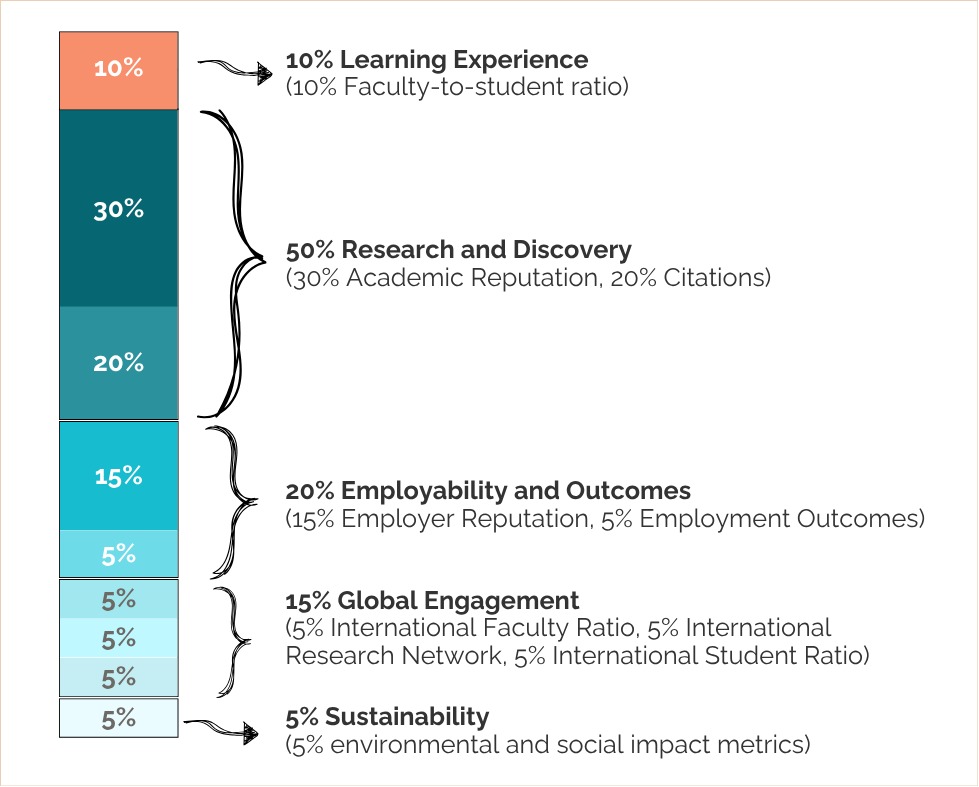
These are all meaningful indicators, particularly when you want to understand a university’s reputation in research and broad international reach, but they don't necessarily tell you what it will feel like to be a student there.
Note for PhD applicants:
What we’re about to discuss is critical for both undergraduate and graduate experiences, but there are differences. The literature discussed here is mostly focused on undergraduate experiences, but many apply to graduate life too.
We’ll tackle specifics on how graduate applicants should think about rankings in another post.
Also, depending on the type of graduate degree you’re going for, your graduate life could interact a lot with undergraduate life, so the following could apply to people you work closely with if not yourself.
So, what else should you consider?
1. Student satisfaction
How satisfied are students and alumni with their academic experience? This goes further than asking whether students “like” their university.
Research highlighted in Inspera’s “Which factors have the biggest impact on student satisfaction?” points to several aspects of program quality that students value, including:
Research highlighted in Inspera’s “Which factors have the biggest impact on student satisfaction?” points to several aspects of program quality that students value, including:
- Great teaching and quality lectures and seminars
- Practical classes that help students gain relevant experience
- Instructors who can clearly explain and illustrate complex concepts
- Quality course materials, including case studies and other resources
- Access to facilities, technology, and other resources that support learning
- Opportunities to interact with peers and instructors
Student satisfaction is also influenced by the social side of university life.
Attending university is a life transition as well as an academic one, and the people students learn and spend time with shape that experience.
Attending university is a life transition as well as an academic one, and the people students learn and spend time with shape that experience.
2. Mental health and social support
University can be a major transition. Students are adapting to a new lifestyle, new academic expectations, and often a new social environment at the same time.
Ask yourself:
Ask yourself:
- What mental health and wellbeing resources are available?
- What support helps students adapt to the stresses of a new lifestyle and study demands?
- Is there access to suicide prevention services?
- Are there buddy or mentoring systems that help students feel heard and supported?
- How does the university help students explore their interests and develop their role in society?
These may not be the first things that come to mind when comparing universities, but they become very important when students encounter challenges.
3. Student retention rate
What happens after students enroll?
How many students stay after their first year? How many graduate? What support is available for students with diverse learning needs?
A university’s ability to attract students is one thing. Supporting those students throughout their studies is another.
How many students stay after their first year? How many graduate? What support is available for students with diverse learning needs?
A university’s ability to attract students is one thing. Supporting those students throughout their studies is another.
A university’s ability to attract students is one thing. Supporting those students throughout their studies is another.
Looking at retention and graduation information can therefore give you another perspective on the student experience.
4. Learning independence
Succeeding in university also requires a significant shift towards independence and personal accountability.
Unlike secondary school, instructors are unlikely to take attendance or regularly check whether you have completed your homework. Your success is often measured through exams, projects, assignments, and other forms of independent work.
Professors will not contact the parents if the student is failing their class, nor are they likely to contact the student. It's up to the student to know their needs and seek support.
So, what support is available as you make that transition?
Ask:
• How does the university help students develop independent learning skills?
• What support is available when academic work becomes difficult?
• How are students encouraged to persevere when they struggle?
And they will struggle sometimes. Learning how to manage that difficulty is part of becoming an independent learner.
5. Cultural adaptation
Finally, what support will help you acclimate to your new location?
This is not only about culture shock and weather. Different cities, states, and countries have different processes, timelines, rules, and laws for everyday things such as banking, healthcare, official documentation, transportation, and other practical aspects of daily life.
This can be true even when moving within the same country.
In the US, for example, I encountered leaps in culture, social life, and legal processes when moving from Pennsylvania to New York State, then to Houston, Texas, and then Los Angeles, California. These four states felt like four different countries - even the English had different phrases and vocabulary. Locals could tell quickly if you "weren't from around here."
Ask:
For international students, these considerations can make or break their experience.
This is not only about culture shock and weather. Different cities, states, and countries have different processes, timelines, rules, and laws for everyday things such as banking, healthcare, official documentation, transportation, and other practical aspects of daily life.
This can be true even when moving within the same country.
In the US, for example, I encountered leaps in culture, social life, and legal processes when moving from Pennsylvania to New York State, then to Houston, Texas, and then Los Angeles, California. These four states felt like four different countries - even the English had different phrases and vocabulary. Locals could tell quickly if you "weren't from around here."
Ask:
- Who can help you navigate your new environment?
- What practical support is available when you arrive?
- How easy is it to access the services you need?
For international students, these considerations can make or break their experience.
So, what should you do?
If you are attracted to a school because of its rankings, that's fine. Rankings can be useful as long as you understand what they are actually designed to measure AND do not make them your only priority.
Dig deeper and think critically about what is good for you.
Before comparing universities, take a step back and reflect on what would make your undergraduate experience successful and healthy. Think about everything from class size to scenery, from academic support to your social environment.
You might ask yourself:
For a full range of factors students consider, check out the Times Higher Education summary of the Hobsons International Student Survey, which questioned over 60,000 students from over 65 universities around the world.
You might ask yourself:
- What are my learning and career goals, and how does the course curriculum align with them?
- In what kind of environment do I learn and live best?
- How do I usually handle stress and pressure?
- What activities make me feel good?
- What kind of support do I seek when things get difficult?
- What tuition fees and living costs can I realistically manage?
- What scholarships, financial aid, or student jobs are available?
For a full range of factors students consider, check out the Times Higher Education summary of the Hobsons International Student Survey, which questioned over 60,000 students from over 65 universities around the world.
Rankings have their value. But understanding what a ranking measures, what it leaves out, and how those criteria relate to your own priorities is just as important as looking at the ranking itself.
So the next time you see a university ranking, think critically about what the ranking means, what it measures, what it leaves out, and whether those things align with what matters to you.
If you’d like to explore the methodology behind the QS World University Rankings discussed above, you can read the QS World University Rankings Methodology.
If you’d like to explore the methodology behind the QS World University Rankings discussed above, you can read the QS World University Rankings Methodology.
Over to you:
Would you add anything or ask anything I haven’t covered here?
Send me an email, I read every one.
Send me an email, I read every one.
References
- Inspera Team. Which factors have the biggest impact on student satisfaction? Inspera (2021).
- Wong, W. H. & Chapman, E. Student satisfaction and interaction in higher education. Higher Education 85, 957–978 (2022).
- Bhardwa, S. Why do students go to university and how do they choose which one? Times Higher Education (2017; updated 2023).
- QS. QS World University Rankings: Methodology. TopUniversities.com (2026).
Know someone you don’t want to make the ranking mistake?
Forward this to them or send them this blog!
Forward this to them or send them this blog!