
Roadmap for this article:
I. Difficult, tough, and unfair: Common but not illegal bad behaviors
II. Favoritism, Safety, and Integrity: Practices and institutional cultures that undermine scientific integrity and physical safety
III. “Introduce him to your boyfriend right away”: Harassment in academia
IV. How should academic culture change? What should I look for while choosing my Ph.D. home?
V. Should I still go to graduate school? Will it be fun and safe?
VI. References
I. Difficult, tough, and unfair: Common but not illegal bad behaviors
II. Favoritism, Safety, and Integrity: Practices and institutional cultures that undermine scientific integrity and physical safety
III. “Introduce him to your boyfriend right away”: Harassment in academia
IV. How should academic culture change? What should I look for while choosing my Ph.D. home?
V. Should I still go to graduate school? Will it be fun and safe?
VI. References
You’re in love with a researcher’s work, they have a great publication record, their reputation will serve you well, so you want to work with them… but would this future advisor really be a good fit for you?
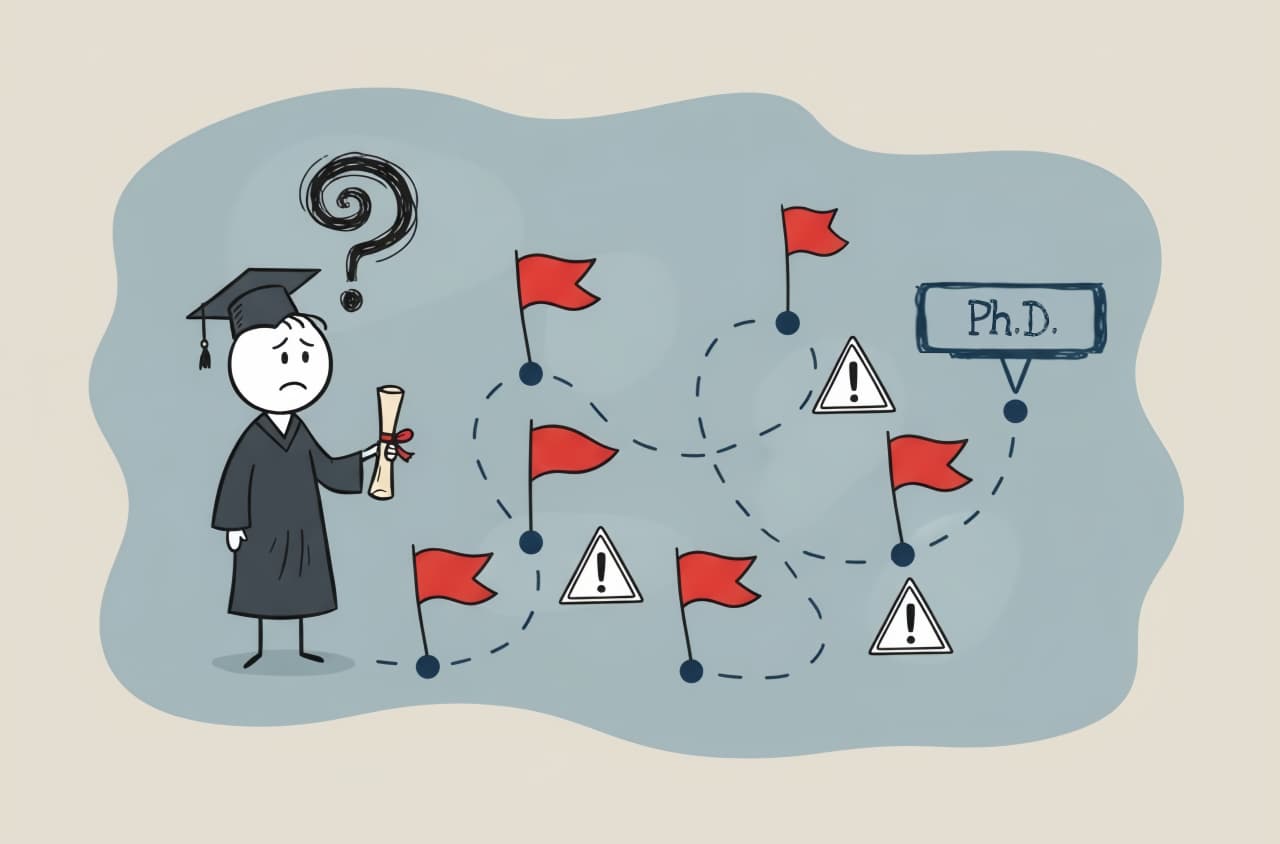
The most influential decision in your PhD journey is not your research topic; it's choosing your advisor. You can’t know everything about them upfront, and no supervisor is perfect, but spotting red flags before you commit can save you years of unnecessary pain.
Here in Part III of Beyond Fame and Funding, our series all about choosing Ph.D. advisors, we’re going to talk about what those red flags might be. You'll activate your radar to detect them, ask better questions, and make the best informed decision you can.
Before we dive in, I’d like to note that this is one of the longest and heaviest posts I’ve written about academia. Some serious s*** has happened, and we’re covering major red flags as comprehensively as we can.
The most influential decision in your PhD journey is not your research topic; it's choosing your advisor. You can’t know everything about them upfront, and no supervisor is perfect, but spotting red flags before you commit can save you years of unnecessary pain.
Here in Part III of Beyond Fame and Funding, our series all about choosing Ph.D. advisors, we’re going to talk about what those red flags might be. You'll activate your radar to detect them, ask better questions, and make the best informed decision you can.
Before we dive in, I’d like to note that this is one of the longest and heaviest posts I’ve written about academia. Some serious s*** has happened, and we’re covering major red flags as comprehensively as we can.
This is not intended to discourage anyone from joining academia or pursuing a Ph.D.
Academia can be a wonderful place, with intellectually stimulating colleagues, smart and quirky students, and in some places, a perfect storm of resources and ideas to embark on decades-long inquiries that expand our knowledge of how things work and what we can change for the better.
I have always loved science because it is borderless. The laws of nature do not care about your name, age, nationality, ethnicity, gender, sexual orientation, able-bodied-ness, nor other ‘identifiers’. Pure water freezes below zero degrees and boils above 100 degrees Celsius regardless of your nationality (at standard conditions). Anyone anywhere can apply the same laws of nature and math to understand crises and devise solutions.
Throughout my career as an academic scientist, I met people from 6 continents and traveled to some of them for the purpose of doing science with other people. As a result, I have an invaluable network of friends and former colleagues connected with 30+ countries and counting, and a beautifully broad and varied perception of how to live and how to science.
So, if you’re enamored by the prospect of a Ph.D., academia, or research, please, join us! We need you.
Research institutions, like any other work environment, contain wonders and flaws. What we’re sharing here comes from our deepest intention for you to have great judgment in charting your journey. We hope that with more people exercising great judgment, academic research settings can evolve to their full positive potential.
I have always loved science because it is borderless. The laws of nature do not care about your name, age, nationality, ethnicity, gender, sexual orientation, able-bodied-ness, nor other ‘identifiers’. Pure water freezes below zero degrees and boils above 100 degrees Celsius regardless of your nationality (at standard conditions). Anyone anywhere can apply the same laws of nature and math to understand crises and devise solutions.
Throughout my career as an academic scientist, I met people from 6 continents and traveled to some of them for the purpose of doing science with other people. As a result, I have an invaluable network of friends and former colleagues connected with 30+ countries and counting, and a beautifully broad and varied perception of how to live and how to science.
So, if you’re enamored by the prospect of a Ph.D., academia, or research, please, join us! We need you.
Research institutions, like any other work environment, contain wonders and flaws. What we’re sharing here comes from our deepest intention for you to have great judgment in charting your journey. We hope that with more people exercising great judgment, academic research settings can evolve to their full positive potential.
I. Difficult, tough, and unfair
I had the good fortune of visiting multiple graduate programs that admitted me. Graduate visiting days were organized by the department and packed full of information sessions, lab visits, social events with graduate students and professors, and a splash of sightseeing to learn about our future home.
One professor had everything to love - innovative research in my area of interest, prolifically published, lots of funding, enough lab space and state-of-the-art equipment as a warehouse. He enjoyed early career success and was justifiably confident.
For this story, we'll call him X. Despite all these attributes to love, I hesitated. The group was huge, 40-50 people (and growing), and the style of mentorship I had thrived in during undergrad involved 1-to-1 interactions with my direct mentor. In a group that large, my preferred dynamic might happen in 'subgroups' but unlikely with my official mentor, the professor, themselves. Plus, a funny gut feeling said, "don't dive in yet".
A friend was now working with X as a Ph.D. student. They wrote me a raving review about X and why I would do well there. When I expressed reservations about my compatibility with X and the group, my contact volunteered a more honest opinion.
"X can be a d*ck,* they said. They mentioned that X could be unfair, probably didn't treat or respect some of his students as well as my previous mentor did, and at times was highly unlikable.
Every professor has quirks though. "Not all professors have benefits that outweigh those quirks or problems." Further details provided by my contact indicated absolute confidence that working for X yielded an exceptional abundance of advantages and benefits.
Multiple students working for high-profile professors echoed, "If you make it through this group, you'll be able to do whatever you want when you leave." Indeed, former Ph.D.'s and postdocs I know from X's group attained desirable and coveted careers in academia and elsewhere.
Any red flags here?
Sometimes it’s a matter of compatibility. Every person, every boss, and each of us has “quirks”. We do our best to find a “fit”, an environment and a group of people where we can thrive for the next 4-8 years.
I’ll never know what happened in the group of X or any other group I didn’t join, as I found this "fit" elsewhere, and it turned out great.
Nonetheless, there are countless ways that advisors can be “tough”, “unfair”, and a “d*ck.” . Some may be red flags for your own compatibility. Some are just wrong.
Multiple contacts with academic and industry experience report a generally lower degree of oversight regarding leadership conduct for researchers in academia. Plus, Ph.D. students have “student” rather than “employee” status. As a result, the extent to which they are protected under universities’ human resources policies varies greatly by country, institute, and nature of funding.
It’s therefore imperative that we pay attention when our gut says, "Hmm, that might be difficult," or "This might not be right for you." Negative dynamics in our relationships with leaders and colleagues do impact our well-being, and that subtracts from our capacity to persist through the hard work towards our Ph.D. goals.
Here are some behaviors you’ll want to learn about from their current and past group members.
You’re unlikely to see these behaviors overtly when meeting your prospective advisor and group members, but you can pick up on signs by asking some well-worded questions and listening carefully to how they talk about their group. Listen for what they exclude as well as what they include.
For more ideas on how to gather information, see Part II of this series, "How do I hunt down intel about my future mentor?"
One professor had everything to love - innovative research in my area of interest, prolifically published, lots of funding, enough lab space and state-of-the-art equipment as a warehouse. He enjoyed early career success and was justifiably confident.
For this story, we'll call him X. Despite all these attributes to love, I hesitated. The group was huge, 40-50 people (and growing), and the style of mentorship I had thrived in during undergrad involved 1-to-1 interactions with my direct mentor. In a group that large, my preferred dynamic might happen in 'subgroups' but unlikely with my official mentor, the professor, themselves. Plus, a funny gut feeling said, "don't dive in yet".
A friend was now working with X as a Ph.D. student. They wrote me a raving review about X and why I would do well there. When I expressed reservations about my compatibility with X and the group, my contact volunteered a more honest opinion.
"X can be a d*ck,* they said. They mentioned that X could be unfair, probably didn't treat or respect some of his students as well as my previous mentor did, and at times was highly unlikable.
Every professor has quirks though. "Not all professors have benefits that outweigh those quirks or problems." Further details provided by my contact indicated absolute confidence that working for X yielded an exceptional abundance of advantages and benefits.
Multiple students working for high-profile professors echoed, "If you make it through this group, you'll be able to do whatever you want when you leave." Indeed, former Ph.D.'s and postdocs I know from X's group attained desirable and coveted careers in academia and elsewhere.
Any red flags here?
Sometimes it’s a matter of compatibility. Every person, every boss, and each of us has “quirks”. We do our best to find a “fit”, an environment and a group of people where we can thrive for the next 4-8 years.
I’ll never know what happened in the group of X or any other group I didn’t join, as I found this "fit" elsewhere, and it turned out great.
Nonetheless, there are countless ways that advisors can be “tough”, “unfair”, and a “d*ck.” . Some may be red flags for your own compatibility. Some are just wrong.
Multiple contacts with academic and industry experience report a generally lower degree of oversight regarding leadership conduct for researchers in academia. Plus, Ph.D. students have “student” rather than “employee” status. As a result, the extent to which they are protected under universities’ human resources policies varies greatly by country, institute, and nature of funding.
It’s therefore imperative that we pay attention when our gut says, "Hmm, that might be difficult," or "This might not be right for you." Negative dynamics in our relationships with leaders and colleagues do impact our well-being, and that subtracts from our capacity to persist through the hard work towards our Ph.D. goals.
Here are some behaviors you’ll want to learn about from their current and past group members.
- Humiliating or personally criticizing students, especially in front of a group or during a meeting. Critiques should always be about the work and ideas; they should not be judgments of the person.
- Pressuring students to complete or rush something when it’s good for them, but not when it's good for students. E.g. “Get me this yesterday”, then they don’t read a draft of students’ manuscripts for publication for months, and their Ph.D. depends on it.
- Discouraging or not supporting students’ specific career interests, networking, or attending conferences.
- Playing favorites or using unhealthy comparisons to motivate students.
- Micromanaging – The supervisor is overly involved in how students conduct the work and manage their time. It is not only controlling, it denies early career scientists the skillsets of questioning, creative problem solving, and essentially… thinking like a scientist.
- Unclear about expectations – Often, this looks like a lot of freedom upfront, then a lot of last minute demands to meet expectations that weren’t communicated earlier.
- Withholding credit and acknowledgement – When they talk about their research, they make it sound like they did it all, rather than crediting members of their group appropriately.
- Visa threats – In many cases, the Ph.D. supervisor must sign off on your visa sponsorship for you to stay in the program and in the country. This power can be taken too far.
You’re unlikely to see these behaviors overtly when meeting your prospective advisor and group members, but you can pick up on signs by asking some well-worded questions and listening carefully to how they talk about their group. Listen for what they exclude as well as what they include.
For more ideas on how to gather information, see Part II of this series, "How do I hunt down intel about my future mentor?"
No supervisor is perfect and neither are we.
The line is ours to draw: What would make it worthwhile to work in an environment with “unfair”, “tough”, or “being a d*ck” behaviors?
When are we better off walking away?
II. Favoritism, Safety, and Integrity
Another contact of mine recently changed Ph.D. advisors. Here’s why:
Let’s dive into these issues more deeply:
1) Favoritism and nepotism – Hiring a family member is generally a bad idea, legal or not. It creates an unhealthy power dynamic of one spouse being in a supervisory role over another.
What does this mean for you? You might question whether the boss makes hiring decisions based on qualifications and fit for the job. Do they choose the best candidates based on these criteria? Or does something personal influence their choice more than it should? What does this suggest about other decisions they make?
- After hiring my contact as his first Ph.D. student, a lab manager also joined the lab. The lab manager’s experience and qualifications didn’t fit the needs to run a molecular biology lab. Turns out that lab manager was the professor’s spouse.
- The lab had a culture of ignoring safety regulations and practices.
- The professor encouraged selective reporting of results.
Let’s dive into these issues more deeply:
1) Favoritism and nepotism – Hiring a family member is generally a bad idea, legal or not. It creates an unhealthy power dynamic of one spouse being in a supervisory role over another.
What does this mean for you? You might question whether the boss makes hiring decisions based on qualifications and fit for the job. Do they choose the best candidates based on these criteria? Or does something personal influence their choice more than it should? What does this suggest about other decisions they make?
If you’re asking these questions and can’t find an answer that brings you peace, that’s a sign that you don’t trust this person. Consider changing course.
Scientific collaboration and integrity rely on trust. Lose trust in a basic area such as choosing personnel, and we’re quickly on a slippery slope to lack of trust in scientific exchange. Furthermore, consequences in the legal and public eye could be irreparable. Technically, favoritism and nepotism are forms of corruption.1–3
2) Ignoring safety regulations and practices – In mild cases, ignoring safety practices means contamination, confusion, clutter, tripping hazards, and/or waste waiting to happen. In the worst case, the accidents are fatal.
In 2008, a 23-year old research associate at the University California Los Angeles (UCLA) suffered an accident while transferring a pyrophoric chemical in a flammable solvent for an experiment. She wasn’t wearing a lab coat, her synthetic sweatshirt caught fire, and she didn’t get under the lab’s safety shower. She died from her burns 18 days later.4
Between her death in early 2009 and 2014, numerous hearings happened, felony charges were brought against the supervising professor and UCLA, and UCLA paid $4.5 million USD to law firms to defend itself and the professor.4,5
The 95-page report by California’s Occupational Safety and Health Administration concluded there was “a systemic breakdown of overall laboratory safety practices at UCLA” that rendered the “University’s required Chemical Hygiene Plan and Injury and Illness Prevention Program essentially non-existent.”4 The Board of Regents of the UC system was fined for “failure to correct unsafe workplace conditions and procedures in a timely manner, failure to require work-appropriate clothing and personal protective equipment (PPE), and failure to provide chemical safety training to employees.”5
In 2010, an explosion at Texas Tech University resulted in one student losing three fingers and suffering eye damage.6 The student and their lab partner were scaling up the synthesis of a product to 10 grams without knowing the specified guidelines of 100 mg due to its reactivity.6
In 2011, an undergraduate physics student at Yale University died in the machine shop when an accident occured while she was working alone with a lathe.7 Since then, the university has better enforced its ‘buddy system’ rule against working alone and required all appropriate equipment to have an easily accessible emergency stop mechanism.7
Investigations of hundreds of university laboratory accidents around the world, including studies focused on United States, China, South Korea, and Lebanon, all point to human behavior as the most common and preventable cause of laboratory accidents.8–13 Accidents include those involving chemicals, equipment, or simple slips and falls due to unmanaged hazards.
The U.S. Chemical Safety and Hazard Investigation Board named the “fiefdom” system as one culprit. PIs have “intellectual and academic territory” in which they can do “pretty much whatever they want” as long as they don’t intrude on another PI’s territory. One result is, “At some academic institutions, (principal investigators) may view laboratory inspections by an outside entity as infringing upon their academic freedom.”6,14,15
The chance of finding an academic lab that is 100% safe and compliant is as high as the chance of finding a natural snowflake in Dubai.
In that case, check the attitude of the PI and the lab culture around safety, training, and risk management. If you do get to visit, you can observe and make some inferences about their attitudes on these issues. Get to know what hazards their work involves - including chemical, equipment, and biological hazards - by reading their papers. Notice what their lab looks like on a regular work day when people are too busy to clean up for appearances.
Visit or not, you can ask some questions about safety training, reinforcement, and whether there is a lab manager and/or safety officer.
2) Ignoring safety regulations and practices – In mild cases, ignoring safety practices means contamination, confusion, clutter, tripping hazards, and/or waste waiting to happen. In the worst case, the accidents are fatal.
In 2008, a 23-year old research associate at the University California Los Angeles (UCLA) suffered an accident while transferring a pyrophoric chemical in a flammable solvent for an experiment. She wasn’t wearing a lab coat, her synthetic sweatshirt caught fire, and she didn’t get under the lab’s safety shower. She died from her burns 18 days later.4
Between her death in early 2009 and 2014, numerous hearings happened, felony charges were brought against the supervising professor and UCLA, and UCLA paid $4.5 million USD to law firms to defend itself and the professor.4,5
The 95-page report by California’s Occupational Safety and Health Administration concluded there was “a systemic breakdown of overall laboratory safety practices at UCLA” that rendered the “University’s required Chemical Hygiene Plan and Injury and Illness Prevention Program essentially non-existent.”4 The Board of Regents of the UC system was fined for “failure to correct unsafe workplace conditions and procedures in a timely manner, failure to require work-appropriate clothing and personal protective equipment (PPE), and failure to provide chemical safety training to employees.”5
In 2010, an explosion at Texas Tech University resulted in one student losing three fingers and suffering eye damage.6 The student and their lab partner were scaling up the synthesis of a product to 10 grams without knowing the specified guidelines of 100 mg due to its reactivity.6
In 2011, an undergraduate physics student at Yale University died in the machine shop when an accident occured while she was working alone with a lathe.7 Since then, the university has better enforced its ‘buddy system’ rule against working alone and required all appropriate equipment to have an easily accessible emergency stop mechanism.7
Investigations of hundreds of university laboratory accidents around the world, including studies focused on United States, China, South Korea, and Lebanon, all point to human behavior as the most common and preventable cause of laboratory accidents.8–13 Accidents include those involving chemicals, equipment, or simple slips and falls due to unmanaged hazards.
The U.S. Chemical Safety and Hazard Investigation Board named the “fiefdom” system as one culprit. PIs have “intellectual and academic territory” in which they can do “pretty much whatever they want” as long as they don’t intrude on another PI’s territory. One result is, “At some academic institutions, (principal investigators) may view laboratory inspections by an outside entity as infringing upon their academic freedom.”6,14,15
The chance of finding an academic lab that is 100% safe and compliant is as high as the chance of finding a natural snowflake in Dubai.
In that case, check the attitude of the PI and the lab culture around safety, training, and risk management. If you do get to visit, you can observe and make some inferences about their attitudes on these issues. Get to know what hazards their work involves - including chemical, equipment, and biological hazards - by reading their papers. Notice what their lab looks like on a regular work day when people are too busy to clean up for appearances.
Visit or not, you can ask some questions about safety training, reinforcement, and whether there is a lab manager and/or safety officer.
If you learn that a professor pushes students through shortcuts such as beginning to work with settings, equipment, chemicals, or reagents before being properly trained, that’s a good sign to reevaluate… and use any measures available to you to protect yourself.
3) Overtly biasing results – Choices such as presenting only positive results, not reporting negative results, or “creative statistics” that make meaning of data that isn’t fully supported all undermine scientific integrity.
In the worst case, unsupported or falsified results get published.
If you hope to lead a career in research, it will be disastrous if your name is associated with a retraction, whether or not it was your fault. Consider it a tombstone on your career. Rebirth is possible, but it's an uphill battle.
For 10+ years, science – especially biology, has been suffering a “reproducibility crisis” or “replication crisis”. In 2020, the Editor-in-Chief of the journal Molecular Brain wrote about authors who were asked to provide raw data before reviewing, “Surprisingly, among those 41 manuscripts, 21 were withdrawn without providing raw data.... I rejected 19 out of the remaining 20 manuscripts because of insufficient raw data. Thus, more than 97% of the 41 manuscripts did not present the raw data supporting their results when requested by an editor, suggesting a possibility that the raw data did not exist from the beginning, at least in some portions of these cases.”16
Other analyses of the reproducibility crisis suggest that only 20-25% of studies in cancer research could be reproduced and about 36% of a collection of psychology studies were reproducible.16,17 This crisis has many causes, from the natural variability of research-grade antibodies to the systemic culture of favoring positive results over reproducibility or negative results.18
In the worst case, unsupported or falsified results get published.
If you hope to lead a career in research, it will be disastrous if your name is associated with a retraction, whether or not it was your fault. Consider it a tombstone on your career. Rebirth is possible, but it's an uphill battle.
For 10+ years, science – especially biology, has been suffering a “reproducibility crisis” or “replication crisis”. In 2020, the Editor-in-Chief of the journal Molecular Brain wrote about authors who were asked to provide raw data before reviewing, “Surprisingly, among those 41 manuscripts, 21 were withdrawn without providing raw data.... I rejected 19 out of the remaining 20 manuscripts because of insufficient raw data. Thus, more than 97% of the 41 manuscripts did not present the raw data supporting their results when requested by an editor, suggesting a possibility that the raw data did not exist from the beginning, at least in some portions of these cases.”16
Other analyses of the reproducibility crisis suggest that only 20-25% of studies in cancer research could be reproduced and about 36% of a collection of psychology studies were reproducible.16,17 This crisis has many causes, from the natural variability of research-grade antibodies to the systemic culture of favoring positive results over reproducibility or negative results.18
What can you do?
One step to avoid contributing to the crisis and to safeguard your reputation as a scientist is to join a group that shows awareness of these issues. This should be easy to do without getting personal. Read their papers. Look at their methods, statistics, and study design. Ask a few questions from a place of curiosity. Notice if you’re learning from the answers, or if your gut says something seems off.
People are unlikely to tell you overtly that they take shortcuts to publications. Listen for signs of rigor in their study design, justification for how they collected and analyzed data, and honesty about the limitations of their study and conclusions.
III. “Introduce him to your boyfriend right away”
This next story comes from a contact searching for a postdoc boss, but it is all the more important for a prospective Ph.D. to pay attention to this dynamic, as the consequences could be more dire. A postdoc can always leave with their Ph.D. intact; a Ph.D. student might have to start over.
My contact was considering a postdoc with a renowned scientist who agreed to endorse her for a fellowship application from a national funding agency. They wrote a 10-page research proposal, did all the administration, and she flew to his lab to interview with his group.
Weeks later, a professor who was like a trusted advisor to her - not her official advisor, more like a friendly intellectual who supported many students by caring about their next career steps and asking tough scientific questions out of interest at your departmental seminars – spoke with her in private.
He said to her, “I know you’re applying to work with [Professor’s name] at [Research Institute]. If you go and work with him, you’ll want to introduce him to your boyfriend right away.”
Apparently, this prospective advisor had a reputation for being especially difficult with women.
She took the idea seriously, having never associated this trusted advisor with unprofessional hearsay. She also reflected on the women she’d met at a conference who shook their heads without explanation when she mentioned this prospective advisor.
On a side but serious note, no woman (or person) should ever have to demonstrate they have an “alpha male” in their life to be treated well by another person. It’s sad that this was proposed, albeit well-intentioned.
On this prospective boss, several flags were already waving together, and it was not a pretty picture. The proposal process had involved some long phone calls with a few questionable offhand comments. A former group member said this advisor “was tough, believe me, you will face all kinds of challenges,” but as with X, he would come through for your career.
Her fellowship application did not succeed, and the professor would not hire her without this funding. She found a clear and enthusiastic offer elsewhere, an offer she gladly accepted.
Can we know for sure that this prospective advisor had behaved inappropriately and selectively towards women?
No, but sometimes we don’t need to know everything about a specific situation to trust that it’s not right for us.
My contact was considering a postdoc with a renowned scientist who agreed to endorse her for a fellowship application from a national funding agency. They wrote a 10-page research proposal, did all the administration, and she flew to his lab to interview with his group.
Weeks later, a professor who was like a trusted advisor to her - not her official advisor, more like a friendly intellectual who supported many students by caring about their next career steps and asking tough scientific questions out of interest at your departmental seminars – spoke with her in private.
He said to her, “I know you’re applying to work with [Professor’s name] at [Research Institute]. If you go and work with him, you’ll want to introduce him to your boyfriend right away.”
Apparently, this prospective advisor had a reputation for being especially difficult with women.
She took the idea seriously, having never associated this trusted advisor with unprofessional hearsay. She also reflected on the women she’d met at a conference who shook their heads without explanation when she mentioned this prospective advisor.
On a side but serious note, no woman (or person) should ever have to demonstrate they have an “alpha male” in their life to be treated well by another person. It’s sad that this was proposed, albeit well-intentioned.
On this prospective boss, several flags were already waving together, and it was not a pretty picture. The proposal process had involved some long phone calls with a few questionable offhand comments. A former group member said this advisor “was tough, believe me, you will face all kinds of challenges,” but as with X, he would come through for your career.
Her fellowship application did not succeed, and the professor would not hire her without this funding. She found a clear and enthusiastic offer elsewhere, an offer she gladly accepted.
Can we know for sure that this prospective advisor had behaved inappropriately and selectively towards women?
No, but sometimes we don’t need to know everything about a specific situation to trust that it’s not right for us.
Harassment in academia
My contact made a choice to protect herself from something implied, albeit unconfirmed, yet too common in academia: harassment.
Harassment in academia has been happening, and it shouldn’t. That includes sexual harassment, and for this discussion the term will encompass both sexual and gender harassment.
Harassment in academia has been happening, and it shouldn’t. That includes sexual harassment, and for this discussion the term will encompass both sexual and gender harassment.
In case you see one referred to without the other, here are some definitions:
Sexual harassment is defined as remarks and behaviors with regard to unwanted sexual attention and solicitation. Gender harassment is defined as discriminatory, degrading, and imposing gender roles.19
These behaviors include verbal remarks, unwanted attention, physical assault, and coercion. They are too common, underreported, and often normalized, and the effects can be compounded for members of multiple minority and/or historically marginalized groups in academia.20–23
A 2018 US National Academies of Sciences, Engineering, and Medicine reported that, across multiple surveys of university systems in the US, 20-50% of female students (undergraduate, graduate, and medical) in these fields had experienced sexual harassment from faculty or staff.20
An English language search turns up more US-based studies than those from other parts of the world, but they do exist. Studies of employees and faculty at universities in Sweden, Japan, Ethiopia noted experiences of harassment and derogatory treatment, though women experienced higher rates of sexual and gender-based harassment than men.19,23,24 For women-specific surveys, 40.5% (137 out of 339) of female staff in south-east Nigeria and 90% (45 out of 50) study participants from two science and technology institutions in Ethiopia reported experiencing some form of sexual harassment.24,25
The victims are not limited to women. A faculty survey (all fields) at a university in Japan reported that 23% of female faculty and 20% of male faculty had experienced direct gender harassment.19 In a 2020 survey of 2723 faculty at the University of Michigan Medical School, 82.5% of women and 65.1% reported at least one incident of sexual harassment from the past year.26
Cultural factors in Asia influence if and how incidences are reported and how they are addressed. “Sexual harassment is a taboo in Asian societies, even in an international metropolis like Hong Kong. This subject is so untouchable that many people avoid speaking its name. Some use other words such that sexual harassment becomes ‘carelessly crossing the line’, ‘making fun’ or ‘pursuit of a romantic relationship’” wrote the Chairman of the Equal Opportunities Commission in the foreword to a territory-wide Study on Sexual Harassment of University Students in Hong Kong published in 2019.27
A 2024 report of Women in STEM in Asia Pacific published by the United Nations Development Program quoted two ‘STEMinists’ in Thailand:
An English language search turns up more US-based studies than those from other parts of the world, but they do exist. Studies of employees and faculty at universities in Sweden, Japan, Ethiopia noted experiences of harassment and derogatory treatment, though women experienced higher rates of sexual and gender-based harassment than men.19,23,24 For women-specific surveys, 40.5% (137 out of 339) of female staff in south-east Nigeria and 90% (45 out of 50) study participants from two science and technology institutions in Ethiopia reported experiencing some form of sexual harassment.24,25
The victims are not limited to women. A faculty survey (all fields) at a university in Japan reported that 23% of female faculty and 20% of male faculty had experienced direct gender harassment.19 In a 2020 survey of 2723 faculty at the University of Michigan Medical School, 82.5% of women and 65.1% reported at least one incident of sexual harassment from the past year.26
Cultural factors in Asia influence if and how incidences are reported and how they are addressed. “Sexual harassment is a taboo in Asian societies, even in an international metropolis like Hong Kong. This subject is so untouchable that many people avoid speaking its name. Some use other words such that sexual harassment becomes ‘carelessly crossing the line’, ‘making fun’ or ‘pursuit of a romantic relationship’” wrote the Chairman of the Equal Opportunities Commission in the foreword to a territory-wide Study on Sexual Harassment of University Students in Hong Kong published in 2019.27
A 2024 report of Women in STEM in Asia Pacific published by the United Nations Development Program quoted two ‘STEMinists’ in Thailand:
- “People who are affected (graduate students) do not want to complain. They do not want to be a black sheep. If they are complaining, they will miss out on certain chances.”28
- “Teachers will comment on the girls’ appearance. In universities and workplaces, there is a weak understanding of these issues, and as a result — no anti-sexual harassment or anti-discrimination policies are put in place.”28
What warning signs can you look for in a group and institutional culture?
Let’s summarize some factors contributing to the prevalence of sexual harassment, then explore what systemic changes have to happen and how you might be part of that. This may not be what you intended to sign up for when you chose to pursue a Ph.D. Like it or not, though, as long as we are in a working environment, our presence and behaviors shape its culture.
Conditions raising the likelihood of sexual harassment occurring include:
Conditions raising the likelihood of sexual harassment occurring include:
- Perceived tolerance & normalization – If there is a track record of intolerant policies and actions, sexual harassment is less likely to occur. Such policies and actions include safe channels for reporting instances, timely investigation, and due process for the target and the accused. Institutions lacking such policies or having a track record of inaction or inadequate action create a perception that such behaviors are tolerated.
- Men outnumbering women – It is still the case that academic work environments in STEM are dominated by men, especially in leadership.
- Hierarchical power structures – When power is highly concentrated with one or few people, or groups are geographically isolated, targets of harassment may have more fear of retaliation by those in power.
- Symbolic compliance with laws – Often, institutions have statements, policies, and trainings in place to prevent sexual harassment, but these alone do not reduce the number of instances. Deeper cultural shifts are needed to eliminate harassment.
- Uninformed leadership – Many well-intentioned leaders lack tools to create a culture that eliminates harassment or to address it when it happens.
IV. How should campus culture change, and what should I look for while choosing my Ph.D. home?
We’ve now covered some serious issues encompassing individual behaviors and institutional cultures. We've discussed big themes of harassment, favoritism, integrity, safety culture, and unfairness.
What is in our power as individuals just getting started on our Ph.D. journey?
First, trust that the research community generally wants to eliminate these issues - better working environments support better science. Many are consciously working to set good examples of respectful and safe working culture, and have departments dedicated to accountability and training for overall improvement. Do a quick Google search of universities with a department dedicated to Research Culture, and you'll see many hits, though mostly in the United Kingdom right now.
No place is perfect, and you can be part of the shift. Getting involved with policies and education around these issues is not for everyone. Our day-to-day presence and conduct already contribute to the tone of our immediate working environment.
From the myriad recommendations in the literature, here are three broad areas that institutions should be working on and what you can find out while you’re considering prospective advisors.20–22
1) Enacting a multi-level campus approach to creating inclusive, respectful, and safe working environments.
This means engaging members of the university community at all levels, including students, staff, faculty, and the highest levels of administration. Gain input from all levels based on lived experience to shape policies, education, and everyday standards adherence to respectful behaviors and confronting instances of disrespectful or unsafe behavior even before they escalate in severity.
What does this mean for you while you’re choosing a Ph.D. home?
Find about department and institutional policies and governments. Through what channels can Ph.D. students voice their concerns and ideas to shape policies, operations, and culture? Many universities have a Graduate Student Association at the university-wide and department levels.
2) Diffusing the power dynamics in graduate education.
The dependent student-professor relationship of Ph.D. students implies that a lot is at stake in this one relationship. This can create fear of retaliation and negative career impacts and feelings of isolation. The National Academies argue that Ph.D. training should include more committee-based advising and mentoring networks.20
What does this mean for you?
Look for a culture of mentorship and support networks that extend beyond research groups. Do students participate in departmental and cross-departmental journal clubs and symposia? Are they encouraged or discouraged from attending conferences, networking, or socializing?
The Ph.D. advisor(s) may be one or two people only, but they are not the only people who can provide listening and guidance. It’s healthy for science, not just you, that more scientists at any level get to know you and your work. This enlivens exchange of ideas for better science and better science culture, as well as providing support when something begins to feel “a bit off”.
3) Treating prevention, education, reporting, support for targets, and ongoing research as an integrated system and culture.
A robust system connecting these areas will raise awareness, transparency, and competencies for preventing and disincentivizing disrespectful behavior.
What does this mean for you?
Look at the institution’s policies and resources. Do they have an office or unit for receiving complaints and managing resolutions? Do they have people advocating for equal opportunities and professionally trained counsellors and psychologists to support students in distress? What is campus security like?
Among members of the lab you’re considering, look for a culture of inclusivity and mutual respect. Do they speak negatively about anyone in a personal way? How does the group leader model professional behavior? How do they deliver feedback? Do students seem to have enough psychological safety to speak up in meetings, about research or otherwise?
If students aren’t speaking up about research when it’s their job to do so, you might wonder if they’ll speak up about other issues.
What is in our power as individuals just getting started on our Ph.D. journey?
First, trust that the research community generally wants to eliminate these issues - better working environments support better science. Many are consciously working to set good examples of respectful and safe working culture, and have departments dedicated to accountability and training for overall improvement. Do a quick Google search of universities with a department dedicated to Research Culture, and you'll see many hits, though mostly in the United Kingdom right now.
No place is perfect, and you can be part of the shift. Getting involved with policies and education around these issues is not for everyone. Our day-to-day presence and conduct already contribute to the tone of our immediate working environment.
From the myriad recommendations in the literature, here are three broad areas that institutions should be working on and what you can find out while you’re considering prospective advisors.20–22
1) Enacting a multi-level campus approach to creating inclusive, respectful, and safe working environments.
This means engaging members of the university community at all levels, including students, staff, faculty, and the highest levels of administration. Gain input from all levels based on lived experience to shape policies, education, and everyday standards adherence to respectful behaviors and confronting instances of disrespectful or unsafe behavior even before they escalate in severity.
What does this mean for you while you’re choosing a Ph.D. home?
Find about department and institutional policies and governments. Through what channels can Ph.D. students voice their concerns and ideas to shape policies, operations, and culture? Many universities have a Graduate Student Association at the university-wide and department levels.
2) Diffusing the power dynamics in graduate education.
The dependent student-professor relationship of Ph.D. students implies that a lot is at stake in this one relationship. This can create fear of retaliation and negative career impacts and feelings of isolation. The National Academies argue that Ph.D. training should include more committee-based advising and mentoring networks.20
What does this mean for you?
Look for a culture of mentorship and support networks that extend beyond research groups. Do students participate in departmental and cross-departmental journal clubs and symposia? Are they encouraged or discouraged from attending conferences, networking, or socializing?
The Ph.D. advisor(s) may be one or two people only, but they are not the only people who can provide listening and guidance. It’s healthy for science, not just you, that more scientists at any level get to know you and your work. This enlivens exchange of ideas for better science and better science culture, as well as providing support when something begins to feel “a bit off”.
3) Treating prevention, education, reporting, support for targets, and ongoing research as an integrated system and culture.
A robust system connecting these areas will raise awareness, transparency, and competencies for preventing and disincentivizing disrespectful behavior.
What does this mean for you?
Look at the institution’s policies and resources. Do they have an office or unit for receiving complaints and managing resolutions? Do they have people advocating for equal opportunities and professionally trained counsellors and psychologists to support students in distress? What is campus security like?
Among members of the lab you’re considering, look for a culture of inclusivity and mutual respect. Do they speak negatively about anyone in a personal way? How does the group leader model professional behavior? How do they deliver feedback? Do students seem to have enough psychological safety to speak up in meetings, about research or otherwise?
If students aren’t speaking up about research when it’s their job to do so, you might wonder if they’ll speak up about other issues.
There’s a lot you can’t witness before you join. You CAN ask direct questions on these topics, listen to the answers, and observe any extra clues in what’s NOT said as well as what is said.
V. Should I still go to graduate school? Will it be fun and safe?
Yes, you should go to graduate school, for the right reasons.
The vast majority of people in research and academics mean well and want their trainees to succeed. Plus, they benefit from the intelligence and tenacity of new minds and perspectives. It is their loss when they lose good people because of a bad working environment.
This article isn’t meant to scare you, but rather to equip you with foresight over hindsight.
Choosing a Ph.D. advisor is a choice of human and leadership dynamics, which directly affect our day-to-day experience and wellbeing in the workplace. These elements influence whether we keep a sharp mind and do our best work, so it’s strategic, not weakness, to look out for our wellbeing.
Knowledge is power. With awareness of what could happen, your “spidey-sense” will be more awake and ready to respond, ask questions, and make informed decisions.
Entrenched patterns don’t shift overnight. It can take multiple generations of students and staff, hundreds and thousands of students and staff making choices that push the standards upwards. These culture shifts facilitate the cross-disciplinary and cross-cultural exchanges needed to advance the discoveries and borderless benefits that science and engineering are meant to provide.
The vast majority of people in research and academics mean well and want their trainees to succeed. Plus, they benefit from the intelligence and tenacity of new minds and perspectives. It is their loss when they lose good people because of a bad working environment.
This article isn’t meant to scare you, but rather to equip you with foresight over hindsight.
Choosing a Ph.D. advisor is a choice of human and leadership dynamics, which directly affect our day-to-day experience and wellbeing in the workplace. These elements influence whether we keep a sharp mind and do our best work, so it’s strategic, not weakness, to look out for our wellbeing.
Knowledge is power. With awareness of what could happen, your “spidey-sense” will be more awake and ready to respond, ask questions, and make informed decisions.
Entrenched patterns don’t shift overnight. It can take multiple generations of students and staff, hundreds and thousands of students and staff making choices that push the standards upwards. These culture shifts facilitate the cross-disciplinary and cross-cultural exchanges needed to advance the discoveries and borderless benefits that science and engineering are meant to provide.
There is no perfect workplace, but some places are moving in the right direction. When you choose your Ph.D. advisor, you also get to choose your role in that movement.
Your turn:
We'd love to hear your reactions.
- What about this discussion resonates with you the most? What doesn't?
- Is there an experience or perspective we should be aware of so we can better guide Ph.D. students?
Feel free to send me an email.
VI. References
1. Maria Ciucurel, D. Nepotism in Academia. European Proceedings of Educational Sciences Education Facing Contemporary World Issues-EDU WORLD 2022, (2023).
2. Arif, A. Is it appropriate for a PI to appoint someone who is a family member? Academia Stack Exchange (2018).
3. KUMAR. V, D. Academic nepotism - all that glitters is not gold. J Adv Med Educ Prof 6, 186–187 (2018).
4. Division of Occupational Safety and Health. University of California Los Angeles, Investigation Report December 23, 2009, Case No. S 1110-003-09. 95
5. Kemsley, J. Lab Death Legal Defense Cost University Of California Nearly $4.5 Million. Chemical & Engineering News (2014).
6. U.S. Chemical Safety Board. CSB Releases Investigation into 2010 Texas Tech Laboratory Accident; Case Study Identifies Systemic Deficiencies in University Safety Management Practices - Investigations - News | CSB (2011).
7. Michele Dufault ’11 dies in Sterling Chemistry Laboratory accident - Yale Daily News.
8. Galasso, A., Luo, H. & Zhu, B. Laboratory safety and research productivity. Research Policy 52, 104827 (2023).
9. Xu, C. et al. Current challenges of university laboratory: Characteristics of human factors and safety management system deficiencies based on accident statistics. Journal of Safety Research 86, 318–335 (2023).
10. Cui, M., Du, W., Fan, L., Wang, J. & Jin, H. Analysis of laboratory safety culture in the university: a case study. International Journal of Occupational Safety and Ergonomics (2025).
11. Wu, G., Yang, Y. & Xu, C. Determination of University Students’ Laboratory Safety Awareness: A Cross-Sectional Study. Journal of Chemical Education.
12. Kim, J. G., Jo, H. J. & Roh, Y. H. Analysis of accidents in chemistry/chemical engineering laboratories in Korea. Process Safety Progress 43, 160–169 (2023).
13. Nasrallah, I. M., El Kak, A. K., Ismaiil, L. A., Nasr, R. R. & Bawab, W. T. Prevalence of Accident Occurrence Among Scientific Laboratory Workers of the Public University in Lebanon and the Impact of Safety Measures. Saf Health Work 13, 155–162 (2022).
14. Benderly, B. L. Crossing the Rubicon. Science (2012).
15. Morris, J. UCLA researcher’s death draws scrutiny to lab safety. Reveal (2012).
16. Miyakawa, T. No raw data, no science: another possible source of the reproducibility crisis. Molecular Brain 13, 24 (2020).
17. Open Science Collaboration. Estimating the reproducibility of psychological science | Science. Science 349, (2015).
18. Genomics, F. L. & Rogers, M. Reproducibility: The science communities’ ticking timebomb. Can we still trust published research? Front Line Genomics (2022).
19. Takeuchi, M. et al. Direct and Indirect Harassment Experiences and Burnout among Academic Faculty in Japan. Tohoku J Exp Med 245, 37–44 (2018).
20. National Academies of Sciences, Engineering, and Medicine. Sexual Harassment of Women: Climate, Culture, and Consequences in Academic Sciences, Engineering, and Medicine | The National Academies Press (2018).
21. Zara, G. et al. Looking for a preventive approach to sexual harassment in academia. A systematic review. Eur J Crim Policy Res (2024).
22. Corbett, E., Barnett, J., Yeomans, L. & Blackwood, L. “That’s just the way it is”: bullying and harassment in STEM academia. International Journal of STEM Education 11, 27 (2024).
23. Pilgaard, F., Agardh, A., Östergren, P. O. & Priebe, G. Association between Experiences of Different Types of Harassment or Derogatory Treatment and Sexual Harassment among Employees at a Large Swedish University. International Journal of Environmental Research and Public Health 20, (2023).
24. Sidelil, L. T., Cuthbert, D. & Spark, C. Institutional betrayal and sexual harassment in STEM institutions: evidence from science and technology universities of Ethiopia. Gender and Education 34, 231–246 (2022).
25. Agbaje, O. S. et al. Workplace gender-based violence and associated factors among university women in Enugu, South-East Nigeria: an institutional-based cross-sectional study. BMC Womens Health 21, 124 (2021).
26. Vargas, E. A. et al. #MedToo: A Large-Scale Examination of the Incidence and Impact of Sexual Harassment of Physicians and Other Faculty at an Academic Medical Center. J Womens Health (Larchmt) 29, 13–20 (2020).
27. Equal Opportunities Commission. Break the Silence: Territory-Wide Study on Sexual Harassment of University Students in Hong Kong. 176 (2019).
28. United Nations Development Programme. Women in Science, Technology, Engineering and Mathematics in the Asia Pacific (2024).
2. Arif, A. Is it appropriate for a PI to appoint someone who is a family member? Academia Stack Exchange (2018).
3. KUMAR. V, D. Academic nepotism - all that glitters is not gold. J Adv Med Educ Prof 6, 186–187 (2018).
4. Division of Occupational Safety and Health. University of California Los Angeles, Investigation Report December 23, 2009, Case No. S 1110-003-09. 95
5. Kemsley, J. Lab Death Legal Defense Cost University Of California Nearly $4.5 Million. Chemical & Engineering News (2014).
6. U.S. Chemical Safety Board. CSB Releases Investigation into 2010 Texas Tech Laboratory Accident; Case Study Identifies Systemic Deficiencies in University Safety Management Practices - Investigations - News | CSB (2011).
7. Michele Dufault ’11 dies in Sterling Chemistry Laboratory accident - Yale Daily News.
8. Galasso, A., Luo, H. & Zhu, B. Laboratory safety and research productivity. Research Policy 52, 104827 (2023).
9. Xu, C. et al. Current challenges of university laboratory: Characteristics of human factors and safety management system deficiencies based on accident statistics. Journal of Safety Research 86, 318–335 (2023).
10. Cui, M., Du, W., Fan, L., Wang, J. & Jin, H. Analysis of laboratory safety culture in the university: a case study. International Journal of Occupational Safety and Ergonomics (2025).
11. Wu, G., Yang, Y. & Xu, C. Determination of University Students’ Laboratory Safety Awareness: A Cross-Sectional Study. Journal of Chemical Education.
12. Kim, J. G., Jo, H. J. & Roh, Y. H. Analysis of accidents in chemistry/chemical engineering laboratories in Korea. Process Safety Progress 43, 160–169 (2023).
13. Nasrallah, I. M., El Kak, A. K., Ismaiil, L. A., Nasr, R. R. & Bawab, W. T. Prevalence of Accident Occurrence Among Scientific Laboratory Workers of the Public University in Lebanon and the Impact of Safety Measures. Saf Health Work 13, 155–162 (2022).
14. Benderly, B. L. Crossing the Rubicon. Science (2012).
15. Morris, J. UCLA researcher’s death draws scrutiny to lab safety. Reveal (2012).
16. Miyakawa, T. No raw data, no science: another possible source of the reproducibility crisis. Molecular Brain 13, 24 (2020).
17. Open Science Collaboration. Estimating the reproducibility of psychological science | Science. Science 349, (2015).
18. Genomics, F. L. & Rogers, M. Reproducibility: The science communities’ ticking timebomb. Can we still trust published research? Front Line Genomics (2022).
19. Takeuchi, M. et al. Direct and Indirect Harassment Experiences and Burnout among Academic Faculty in Japan. Tohoku J Exp Med 245, 37–44 (2018).
20. National Academies of Sciences, Engineering, and Medicine. Sexual Harassment of Women: Climate, Culture, and Consequences in Academic Sciences, Engineering, and Medicine | The National Academies Press (2018).
21. Zara, G. et al. Looking for a preventive approach to sexual harassment in academia. A systematic review. Eur J Crim Policy Res (2024).
22. Corbett, E., Barnett, J., Yeomans, L. & Blackwood, L. “That’s just the way it is”: bullying and harassment in STEM academia. International Journal of STEM Education 11, 27 (2024).
23. Pilgaard, F., Agardh, A., Östergren, P. O. & Priebe, G. Association between Experiences of Different Types of Harassment or Derogatory Treatment and Sexual Harassment among Employees at a Large Swedish University. International Journal of Environmental Research and Public Health 20, (2023).
24. Sidelil, L. T., Cuthbert, D. & Spark, C. Institutional betrayal and sexual harassment in STEM institutions: evidence from science and technology universities of Ethiopia. Gender and Education 34, 231–246 (2022).
25. Agbaje, O. S. et al. Workplace gender-based violence and associated factors among university women in Enugu, South-East Nigeria: an institutional-based cross-sectional study. BMC Womens Health 21, 124 (2021).
26. Vargas, E. A. et al. #MedToo: A Large-Scale Examination of the Incidence and Impact of Sexual Harassment of Physicians and Other Faculty at an Academic Medical Center. J Womens Health (Larchmt) 29, 13–20 (2020).
27. Equal Opportunities Commission. Break the Silence: Territory-Wide Study on Sexual Harassment of University Students in Hong Kong. 176 (2019).
28. United Nations Development Programme. Women in Science, Technology, Engineering and Mathematics in the Asia Pacific (2024).
Considering a Ph.D.? Choosing an advisor? Need an ear from someone who's been there?
Fill out my contact form to book a 30-minute consultation. It's free.
Love this post and want to receive new stories like this in your inbox each month?
Subscribe to the monthly newsletter here!
Fill out my contact form to book a 30-minute consultation. It's free.
Love this post and want to receive new stories like this in your inbox each month?
Subscribe to the monthly newsletter here!