
I struggled with mentoring for many years during my career in scientific research.
First, I was easy-going, open to too many ideas, ready to spend hours explaining results, and readily accepted excuses for a student not showing up as expected.
Right after I earned my PhD, I became controlling, hovering over students during experiments on Sundays, dismissing many ideas without fair evaluation, and squeezing as much work out of people working with me (and out of myself).
To be fair, it wasn’t just me. I have observed many supervisors do very little direct mentoring, but they were tenured professors with an official supervisory relationship over those in their group, and they could delegate.
I had no official title as a manager or official supervisor to anyone.
I realized that if I wanted my project to move forward with help, I had to recruit students as collaborators with genuine buy-in.
During this era, I attended a workshop about Team Science by a team from the National Institutes of Health (NIH).
By then, several students had abandoned my project. I still needed help with the project, but I knew that my leadership was a problem.
The guest speakers, Michelle Bennett and Howard Gadlin, gave an excellent seminar about why some teams can do more than the sum of the parts, and the effects of a more diverse team on the scientific outputs and reach.
Afterwards, I met with one of the guest speakers and confessed to her my crimes in mentoring and feelings of shame and loneliness, things that I was not able to tell people at work.
She gave me hope in two ways.
First, she said, “You know Liane, you’re actually pretty self-aware.”
Given her leadership role in the NIH, I imagined that she had seen a lot.
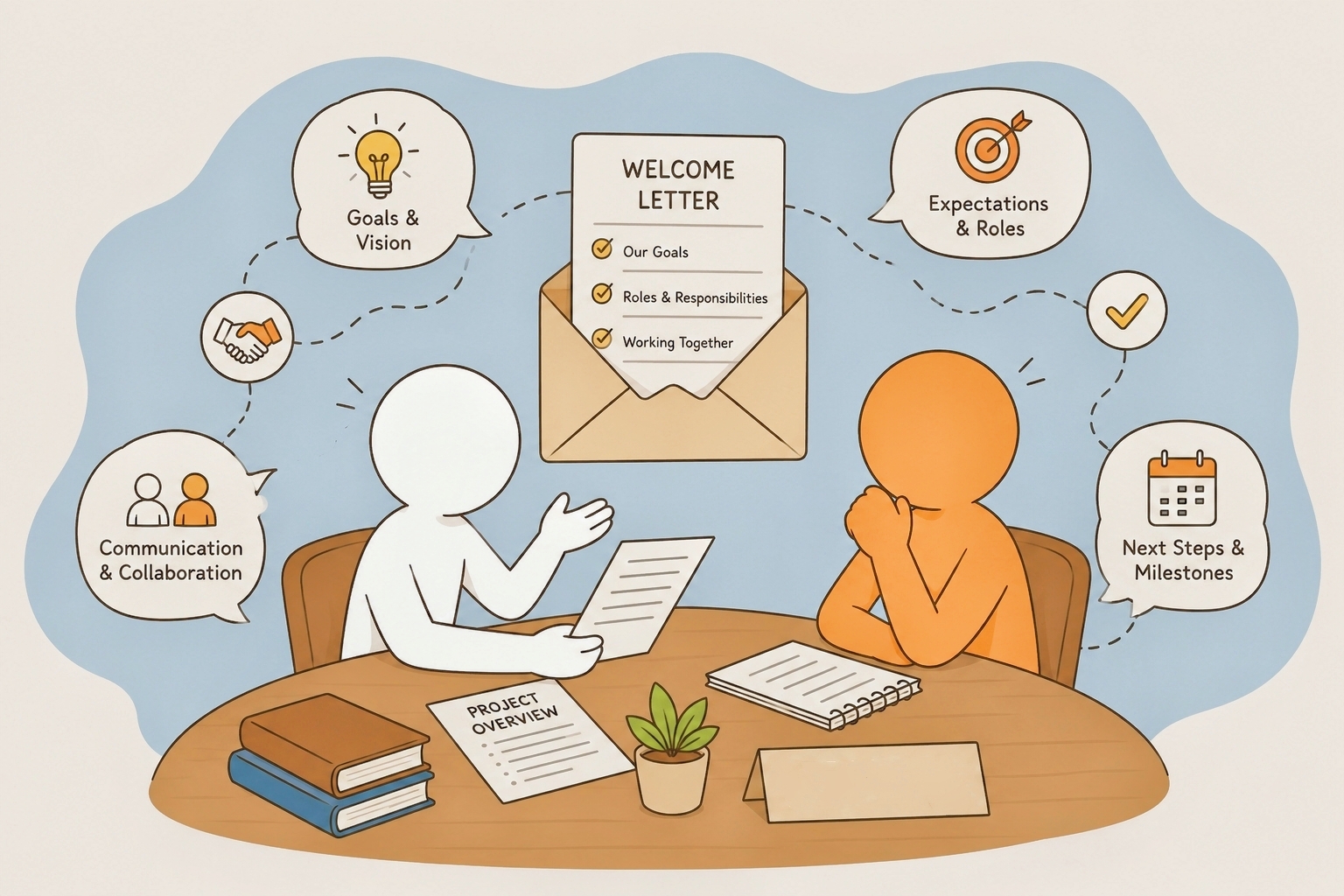
Then, she introduced me to the ‘Welcome Letter’ and where I could download a template
First, I was easy-going, open to too many ideas, ready to spend hours explaining results, and readily accepted excuses for a student not showing up as expected.
Right after I earned my PhD, I became controlling, hovering over students during experiments on Sundays, dismissing many ideas without fair evaluation, and squeezing as much work out of people working with me (and out of myself).
To be fair, it wasn’t just me. I have observed many supervisors do very little direct mentoring, but they were tenured professors with an official supervisory relationship over those in their group, and they could delegate.
I had no official title as a manager or official supervisor to anyone.
I realized that if I wanted my project to move forward with help, I had to recruit students as collaborators with genuine buy-in.
During this era, I attended a workshop about Team Science by a team from the National Institutes of Health (NIH).
By then, several students had abandoned my project. I still needed help with the project, but I knew that my leadership was a problem.
The guest speakers, Michelle Bennett and Howard Gadlin, gave an excellent seminar about why some teams can do more than the sum of the parts, and the effects of a more diverse team on the scientific outputs and reach.
Afterwards, I met with one of the guest speakers and confessed to her my crimes in mentoring and feelings of shame and loneliness, things that I was not able to tell people at work.
She gave me hope in two ways.
First, she said, “You know Liane, you’re actually pretty self-aware.”
Given her leadership role in the NIH, I imagined that she had seen a lot.
Then, she introduced me to the ‘Welcome Letter’ and where I could download a template
What exactly is a welcome letter?
A Welcome Letter is a tool designed to clarify expectations, foster trust, and improve how teams function. Topics may include roles, communication, authorship, career development, conflict management, and other aspects of collaboration.
Simply put, a Welcome Letter is a way of making expectations explicit.
It is a tool used at the beginning of a mentoring or supervisory relationship to create a shared understanding and support healthy, productive working relationships.
Simply put, a Welcome Letter is a way of making expectations explicit.
It is a tool used at the beginning of a mentoring or supervisory relationship to create a shared understanding and support healthy, productive working relationships.
As Michelle Bennett and coworkers write in their 2014 Commentary entitled “The ‘Welcome Letter’: A Useful Tool for Laboratories and Teams” published in the Journal of Translational Medicine & Epidemiology:
“Many PIs seem to assume that their expectations about how the lab functions make so much sense that they do not have to spell it out. Consequently, when confronted with lab members who do not meet their expectations, they often attribute the problem to the lab member’s personal failings. Unfortunately, this can result in loss of trust, miscommunication, and frustration on both sides.”
Across businesses, organizations, and summer camp teams, the ability to clearly set expectations is recognized as an essential leadership skill.
Interestingly, individual leaders in research laboratories and scientific collaborations often struggle to communicate what they expect of people who work with them. Often, they fail to see the value in doing so, and/or do not express what their lab members can expect in return.
Their article and Welcome Letter example (linked at the end) changed my research career for good.
Interestingly, individual leaders in research laboratories and scientific collaborations often struggle to communicate what they expect of people who work with them. Often, they fail to see the value in doing so, and/or do not express what their lab members can expect in return.
Their article and Welcome Letter example (linked at the end) changed my research career for good.
Now when you see the Welcome Letter example, it might feel like another mountain on your to-do plate. It is 8 single-spaced pages packed densely with prose spelling out:
It will take time to get clear on all the points you want to communicate, and you do NOT have to use it all.
I also did not use the letter right away, but the example led me to journal about my goals and expectations, and to become aware of my working and communication habits.
I also became curious about my mentees’ aspirations and articulated the ways in which I could support their career development.
This already led to better onboarding when a new member joined my project, and helped me repair relationships with existing mentees.
Eventually, I did flush out a Welcome Letter of my own and use it as a living framework for functioning working relationships with my mentees.
- Goals - of the research group, of the project
- Roles - what you can expect from the PI, other lab members
- Laboratory interactions and functioning - team meetings, journal clubs, sharing space & supplies, time in the lab, vacations, attending outside meetings, professional etiquette, expected work habits
- Code of conduct - scientific integrity & ethics, record keeping & sharing data, presentations, responsibility for data storage & stewardship, lab values
- Communication - seminars, abstracts & manuscripts, meeting logistics, expectations for participation & contribution, conflict management
- Authorship - sharing credit, decision processes, review and revision procedures & responsibilities, acknowledgements
- Career development - career planning, networking, leadership development, training in science communication & business communication, reference letters
- Science administration & leadership skills - manuscript review, writing grants
- Mentoring - finding mentors outside the lab, providing mentorship
- Other resources - employee/student assistance, counseling, housing, local information
It will take time to get clear on all the points you want to communicate, and you do NOT have to use it all.
I also did not use the letter right away, but the example led me to journal about my goals and expectations, and to become aware of my working and communication habits.
I also became curious about my mentees’ aspirations and articulated the ways in which I could support their career development.
This already led to better onboarding when a new member joined my project, and helped me repair relationships with existing mentees.
Eventually, I did flush out a Welcome Letter of my own and use it as a living framework for functioning working relationships with my mentees.
Here’s a flow I recommend - feel free to try it and adapt:
1. Draft your Welcome Letter, but don’t share it before you’ve met the mentee. This can be mostly the same template you use for all of your team members.
2. Have a conversation with the mentee (or direct report) and find out answers to some of the questions addressed in the Welcome Letter.
3. Revise and personalize your Welcome Letter accordingly, informed by this conversation. Sign it, like you would a letter.
4. Have another conversation where you present the Welcome Letter to them. You do NOT need to go through all details with them.
5. If appropriate, revise again.
6. If appropriate: Once you have a version you can both accept, sign it and ask the mentee to sign it as well.
Remember that any agreement is based on the most complete information and best intentions available at the time.
2. Have a conversation with the mentee (or direct report) and find out answers to some of the questions addressed in the Welcome Letter.
- What would they like to learn?
- What relevant experiences have they had before? What are they already good at?
- What are their career aspirations - and life - perhaps they have another country/region where they would like to go next and need to meet specific qualifications?
- This is not irrelevant to you as the leader. Such details may not be your responsibility, but knowing what they want and what motivates them allows you to help them connect their work under your leadership with those goals.
3. Revise and personalize your Welcome Letter accordingly, informed by this conversation. Sign it, like you would a letter.
4. Have another conversation where you present the Welcome Letter to them. You do NOT need to go through all details with them.
- You can let them know the main intent is to establish a framework for a living working agreement, intended to promote transparency through clear expectations and two-way communication.
- Invite them to read it on their own time, and raise any questions or concerns.
5. If appropriate, revise again.
6. If appropriate: Once you have a version you can both accept, sign it and ask the mentee to sign it as well.
Remember that any agreement is based on the most complete information and best intentions available at the time.
The Welcome Letter is a living agreement - should circumstances arise that change expectations, e.g. a global pandemic or the onslaught of AI tools, revise accordingly.
As a mentor and business owner, the Welcome Letter gives me the gift of clarity every time. With a clear purpose of my work and my collaborations, I am able to act and communicate in alignment with my mission and values.
If you'd like to learn more or adapt this approach to your own context, you can find the original article and the free-to-download Welcome Letter template here.
Over to you:
- What is one expectation you wish had been made clearer earlier in your career?
- How is that reflected in your current Welcome Letter or onboarding process?
Feel free to send me an email. I'd love to hear your experiences.
Enjoyed this article?
I share reflections on mentoring, leadership, career development, science, and professional growth through my monthly newsletter.
Subscribe here to receive future articles directly in your inbox.
Subscribe here to receive future articles directly in your inbox.